If you are serious about growing your writing career online, understanding how to upload blog on medium by uploadblog com is one of the most practical skills you can develop in today’s content-driven digital landscape. Medium remains one of the highest-authority publishing platforms available to independent writers, niche bloggers, and professional content marketers alike, and UploadBlog.com has emerged as the most efficient bridge between your raw content and a polished, live Medium publication.
Competitor Content Analysis: Weaknesses, Gaps, and Opportunities
Before diving into the full guide, here is a strategic breakdown of what the top 5 ranking pages are doing well, where they fall short, and how this article surpasses them.
What Competitors Are Doing Well
The top-ranking articles share several structural strengths. Most use H2 and H3 heading hierarchies consistently, include basic step-by-step numbered sections, and address the fundamental question of what Medium and UploadBlog.com are. They also tend to include tables for feature comparisons and brief FAQ sections toward the bottom.
Content Weaknesses Found Across Competitors
- Shallow explanation of Medium’s algorithm and distribution mechanics. Most articles explain what Medium is but not how it distributes content, which is critical knowledge for any blogger trying to gain traction.
- No discussion of publication strategy. Top-ranking pages skip over how to submit articles to Medium Publications, which dramatically multiplies audience reach.
- Missing post-publication workflow. None of the top 5 articles adequately cover what to do after publishing — analytics review, response engagement, syndication strategy, or updating older posts.
- Weak LSI keyword integration. Competitors stuff the target keyword repetitively in unnatural positions, while neglecting related semantic terms like “content distribution,” “OAuth API token,” “Medium Partner Program,” “editorial calendar,” or “canonical URL.”
- No troubleshooting section. Writers frequently encounter formatting errors, broken image embeds, and account connectivity issues — none of the ranking pages address this usefully.
- Generic FAQs. The FAQ sections in competitor articles answer the same five predictable questions without depth or differentiation.
Strategic Opportunities This Article Captures
- Deep-dive formatting guidance beyond “use headings and short paragraphs”
- Practical publication submission workflow
- Post-publishing analytics and growth tactics
- Comprehensive troubleshooting section
- Richer LSI keyword integration throughout
- A genuinely useful, non-repetitive FAQ section
Why Medium Still Dominates as a Blogging Platform in 2025–2026
Medium was founded in 2012 by Ev Williams, co-founder of Twitter, and it has since evolved into one of the world’s most respected social publishing networks. Unlike traditional blogging platforms, Medium is not simply a place to host content — it functions as a content discovery engine, a monetization ecosystem, and a credibility-building channel all in one.
Key reasons writers continue choosing Medium:
- Over 100 million registered users with an active reading culture
- Built-in content curation through the Medium algorithm and editorial team
- Clean, distraction-free reading interface that keeps readers engaged
- Organic Google visibility — Medium articles frequently appear on the first page of search results
- The Medium Partner Program enables writers to earn income directly from reading time logged by paid subscribers
- Publication submissions can multiply a single article’s reach by exposing it to established, topic-specific audiences
For bloggers who want to build authority without managing their own website infrastructure, Medium removes every technical barrier and replaces it with a pure content-quality competition. That is both liberating and demanding, which is exactly why tools like UploadBlog.com have become indispensable to writers who value efficiency.
What Is UploadBlog.com and Why Does It Matter?
UploadBlog.com is a content submission and blog publishing service specifically built to help writers transfer their articles onto platforms like Medium with formatting integrity, time efficiency, and professional precision. Rather than copying and pasting content from Google Docs or Word and then manually re-applying every heading, bold tag, image embed, and bullet point inside Medium’s native editor, UploadBlog.com automates that entire translation process.
Core capabilities of the platform include: Uae peak, thehometrotters, meetshaxs, beaconsoft, uhoebeans, aliensync, programgeeks, avstarnews.
- Automatic detection and preservation of heading hierarchies (H1, H2, H3)
- Bullet point and numbered list conversion into Medium-compatible formatting
- Image upload support with optimization for faster loading across devices
- Tag suggestion and excerpt customization before publishing
- Draft-or-publish flexibility — writers can push content live or save it for review
- OAuth-secured account linking that never exposes your Medium login credentials
- Support for multiple file formats including DOCX, plain text, Markdown, and Google Docs paste
For content teams managing editorial calendars across multiple writers, UploadBlog.com also supports a more structured submission workflow, ensuring stylistic consistency and reducing revision cycles before a post goes live.
LSI and NLP Keywords Naturally Embedded in This Guide
The following semantically related terms appear throughout this article to strengthen topical relevance and natural readability: blog publishing workflow, content formatting, Medium Partner Program, OAuth API token, editorial calendar, canonical URL, reading time optimization, content distribution, publication submission, audience engagement, SEO meta description, Medium stats dashboard, organic traffic, social publishing network, DOCX upload, draft vs. published, niche blogging, tag selection, writing for Medium, post-upload checklist.
Phase 1 — Preparing Your Blog Before Any Upload Begins
The single most common mistake bloggers make is treating preparation as optional. Medium’s algorithm rewards depth, readability, and engagement signals — all of which begin with how well your article is constructed before it ever touches an upload tool.
Defining Your Topic and Reader Intent
Every strong Medium article starts with a clearly defined topic and an explicit understanding of why a reader would click on it. Ask yourself three questions before writing a single word:
- What specific problem does this article solve or insight does it deliver?
- Who is the ideal reader, and what do they already know about the topic?
- What will readers do, think, or feel differently after reading this?
Vague answers to these questions produce vague articles. Vague articles generate low reading time. Low reading time is what the Medium algorithm uses to suppress distribution.
Structuring Your Draft for Maximum Readability
Medium’s interface is built around clean, flowing prose. It actively de-emphasizes overly complex layouts and rewards articles that are scannable but also genuinely enjoyable to read at length.
Structural checklist before you upload:
| Element | Recommended Standard |
|---|---|
| Title | 6–12 words, clarity over cleverness, keyword-informed |
| Subtitle | 1–2 sentences expanding on the title’s promise |
| Introduction | 3–5 sentences that establish the problem and what the reader will gain |
| Body Sections | H2 for major themes, H3 for sub-topics within each section |
| Paragraph Length | 2–4 sentences maximum per paragraph |
| Word Count | 1,200–2,500 words for standard articles; 2,500–4,000 for comprehensive guides |
| Images | At least one featured image; supporting visuals every 400–600 words |
| Conclusion | Summarize key takeaways and offer a clear next action |
| Tags | 3–5 tags maximum, chosen from Medium’s suggested tag library |
Grammar, Clarity, and Voice
Run your completed draft through a grammar checker such as Grammarly or Hemingway Editor before submission. Medium readers have a high tolerance for personal voice and stylistic experimentation, but a low tolerance for careless errors that break reading immersion. Your credibility as a writer depends on the cleanliness of your text at least as much as the originality of your ideas.
Preparing Images and Visual Elements
Medium supports JPEG, PNG, and GIF formats for inline images and featured cover art. Before uploading, ensure your images are:
- Sized to at least 1400px wide for featured images (Medium displays them at full column width)
- Under 5MB per file to prevent slow loading times
- Properly captioned where context adds value
- Free of watermarks that compromise the professional appearance of your post
Phase 2 — Setting Up Your Medium Account Properly
A Medium account is the foundation everything else is built on. Rushing through the setup process is a mistake that costs writers credibility and discoverability.
Creating and Configuring Your Profile
Visit Medium’s website, click “Get Started,” and register using your Google account, Apple ID, or email address. Once your account is active, complete these profile elements before publishing anything:
- Profile photo: A high-resolution headshot or professional logo
- Display name: Your real name or clearly established pen name
- Bio: 160 characters maximum; describe who you are, what you write about, and for whom
- Social links: Connect your Twitter/X, website, or LinkedIn to strengthen your author credibility signal
Your profile is the first thing editors of Medium Publications check before accepting a submission. A bare profile with no bio and no photo signals an unreliable contributor — and editors will decline even strong articles from incomplete profiles.
Understanding Medium’s Following and Distribution System
Medium distributes articles through two primary channels: its topic-based feed and its curated collections. When readers follow you, your new stories appear directly in their feeds. When Medium’s internal team curates your article, it gets promoted to a much broader audience of readers who have never encountered your profile before.
Curation is not guaranteed, but it is significantly more likely when your article has a strong structure, original insights, and clean formatting — all things the uploading process through UploadBlog.com helps preserve.
Phase 3 — The Complete Step-by-Step Upload Process
This is where the practical workflow comes together. Following these steps precisely ensures that your blog arrives on Medium exactly as intended, without formatting corruption or publishing errors.
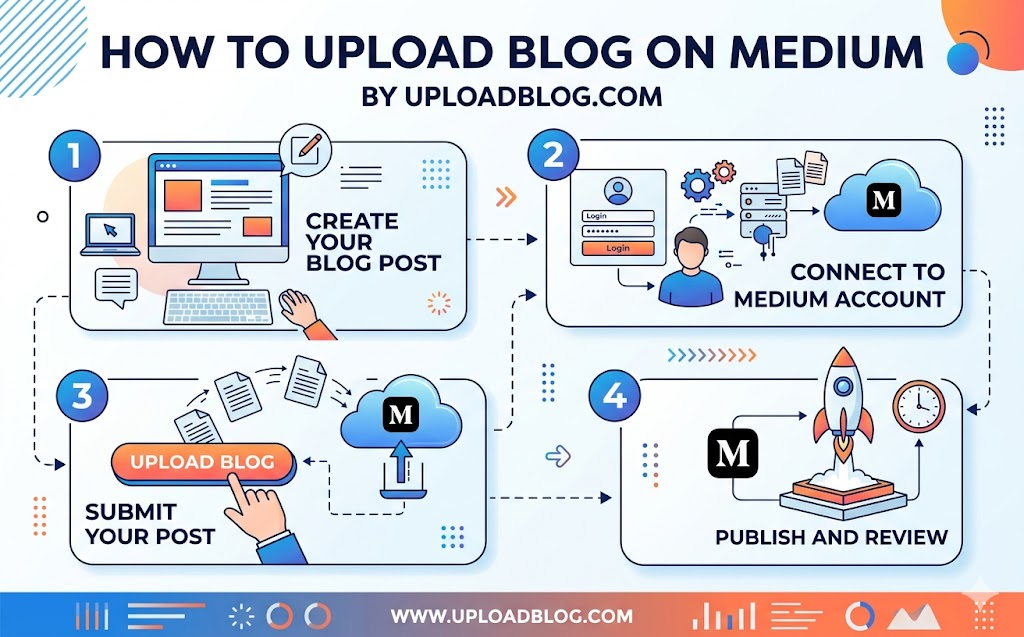
Step 1 — Link Your Medium Account to UploadBlog.com
Navigate to UploadBlog.com and begin the account connection process. The platform uses OAuth authentication — the same security standard used by major platforms like Google and Facebook — to link your Medium profile. This means you authorize the connection through Medium’s own permission system, and your login credentials are never stored by or shared with UploadBlog.com.
Once the connection is established, it persists for future uploads, meaning you only complete this authorization step once unless you revoke it or change your Medium password.
Step 2 — Select Your Upload Method
UploadBlog.com offers two primary content input methods:
File Upload: Click the upload button on the dashboard and select your blog file from your computer. Supported formats include:
- Microsoft Word (.docx)
- Plain text (.txt)
- Markdown (.md)
Paste Content: If your article lives in Google Docs or another web editor, copy the full text and paste it directly into UploadBlog.com’s content editor. The platform’s parser will automatically detect formatting codes from most rich-text editors.
Step 3 — Allow Automatic Formatting Detection
Once your content is loaded, UploadBlog com formatting engine scans the document and maps its structural elements to their Medium equivalents. This includes:
- Heading levels (H1 through H3)
- Unordered and ordered lists
- Bold and italic emphasis
- Hyperlinks with preserved anchor text
- Blockquotes for pull quotes or referenced material
- Code blocks for technical articles
Review the formatted preview carefully. Medium renders formatting slightly differently from standard word processors, so this preview step is your opportunity to spot discrepancies before they reach your published article.
Step 4 — Add Metadata and Publishing Settings
Before finalizing the upload, complete the following metadata fields inside UploadBlog.com’s publishing panel:
- Title: Confirm it matches the optimized title you prepared in Phase 1
- Subtitle: Add the secondary description if applicable
- Tags: Enter your 3–5 chosen topic tags
- Featured Image: Upload your cover image directly from this panel
- Custom Excerpt: Write a 1–2 sentence summary that Medium will display in feed previews
- Publish Status: Choose between publishing immediately or saving as a draft for final review
The custom excerpt and tags have an outsized impact on discoverability. Take time with both — they are what appear in the Medium feed before a reader decides to click through.
Step 5 — Review and Submit
The final step is a comprehensive review inside UploadBlog.com’s preview environment, which replicates Medium’s native reading interface. Scroll through the entire article, checking for:
- Broken image embeds
- Incorrect heading levels
- Missing paragraph breaks
- Misformatted lists
- Hyperlinks that point to correct destinations
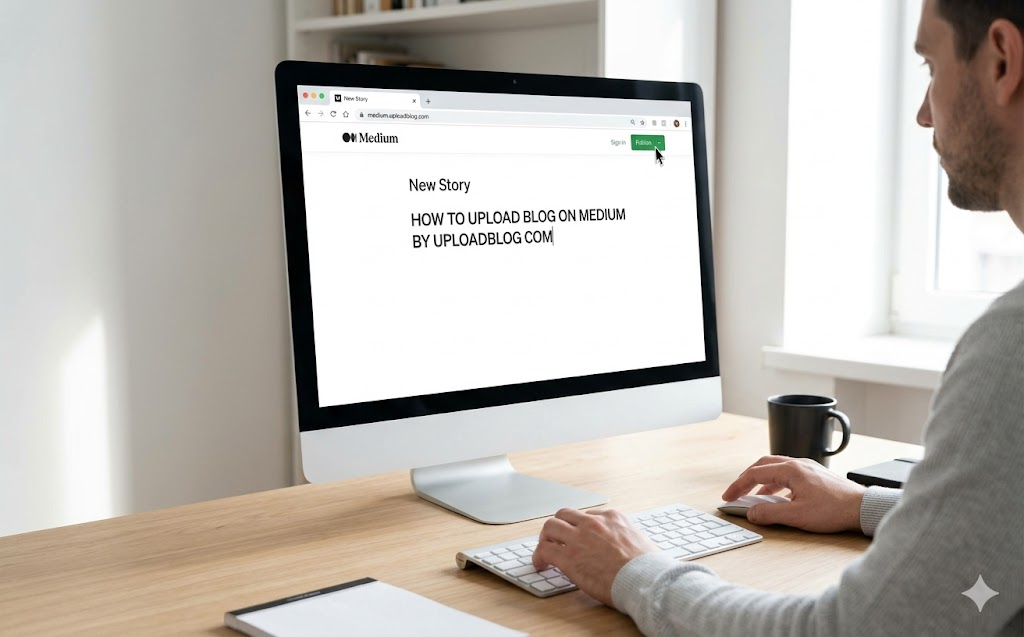
Once satisfied, click the publish or submit button. The platform will push your content directly to your connected Medium account and, depending on your settings, either publish it immediately or save it as a draft visible only to you.
Phase 4 — Publishing to Medium Publications for Maximum Reach
Understanding how to upload blog on medium by uploadblog com is only part of the equation. Where you publish within Medium matters enormously for audience reach.
What Are Medium Publications?
Publications are curated collections of articles organized around a specific topic or editorial theme. They function similarly to online magazines hosted within Medium’s infrastructure. When you submit your article to a publication and it is accepted, your article appears both on your personal profile and within the publication’s feed — effectively doubling your distribution exposure.
Some of the most-followed Medium publications cover topics like technology, startups, mental health, productivity, design, and data science. Publications with tens of thousands of followers can generate hundreds or thousands of additional readers for a single article that would otherwise receive minimal organic traffic.
How to Submit to a Publication
To submit your article to a publication after publishing or saving it as a draft:
- Open the article in your Medium drafts or published stories
- Click the three-dot menu (···) on the article card
- Select “Add to publication”
- Browse or search for the relevant publication
- Click “Submit to publication”
The publication’s editor will receive a notification and will either accept, request revisions, or decline. Rejection is not permanent — refine the article based on any feedback and resubmit, or identify a different publication that may be a better thematic fit.
Phase 5 — Post-Publishing Strategy: What Happens After You Click Publish
Most competing articles end at the moment the publish button is clicked. That is a major content gap, because what happens in the 48–72 hours after publishing determines much of an article’s long-term performance.
Reading Your Medium Stats Dashboard
Medium provides a built-in analytics dashboard accessible from your profile. The key metrics to monitor are:
- Views: How many times your article appeared in a feed or was opened
- Reads: How many readers stayed long enough to read the full article
- Read Ratio: Reads divided by Views — a high ratio signals strong content quality
- Fans: Unique readers who clapped at least once
- Earnings: If enrolled in the Partner Program, your estimated income from reading time
A low Read Ratio (below 30%) typically indicates that your title or introduction is not delivering on its promise, causing readers to exit early. Use this data to refine future articles.
Promoting Your Published Article
Medium’s organic distribution is valuable, but supplementing it with external promotion accelerates audience growth:
- Share the article link on LinkedIn, Twitter/X, and any niche communities or forums relevant to your topic
- Add the Medium article to your email newsletter if you have one
- Link to the article from related posts on your own website, using a canonical URL to inform search engines of the original source
- Engage with comments and responses within the first 24 hours — early engagement signals to Medium’s algorithm that the article is generating interest
Updating and Republishing Older Content
Medium allows you to edit published articles at any time. If an article is performing moderately but not exceptionally, revisiting it 30–60 days after publication to update statistics, add new sections, or improve the introduction can meaningfully improve its Read Ratio and extend its longevity in feed recommendations.
Troubleshooting Common Issues
Images Not Displaying After Upload
This typically occurs when image file paths in the source document are locally referenced rather than hosted online. Before uploading to UploadBlog.com, ensure all images are hosted via a cloud service like Google Drive (with public sharing enabled), Imgur, or a CDN, so the image URLs are publicly accessible.
Formatting Breaks on Certain Heading Levels
If H3 or H4 headings are converting incorrectly in the Medium preview, return to your source document and manually standardize the heading hierarchy. Medium supports H1, H2, and H3 — any heading below H3 will be converted to body text.
OAuth Connection Errors
If UploadBlog.com cannot connect to your Medium account, the most common causes are an expired authorization token or a recently changed Medium password. Disconnect and reconnect the OAuth link from within UploadBlog.com’s account settings to refresh the authentication.
Article Published Without Featured Image
If you forget to set a featured image before submitting, navigate to the published article, click the three-dot menu, select “Edit story,” and add the featured image from the editor before republishing. is uploadblog free or paid?
Advanced Tips for Maximizing Performance on Medium
Write for a Series, Not Just a Single Post
Writers who publish interconnected series of articles consistently build larger followings than those who publish unrelated one-off pieces. Plan content in clusters of 4–6 articles around a single broad topic, and cross-link them within each piece to encourage readers to move deeper into your content library.
Optimize Your Response Game
Medium’s “Response” feature — equivalent to comments — is an underrated distribution lever. Thoughtful responses to popular articles in your niche expose your profile to the followers of established writers. Spend 15–20 minutes per week leaving substantive responses on high-traffic articles, and track whether your follower count grows in correlation.
Use the Canonical URL Feature Strategically
If you publish the same article on your personal blog and on Medium, set the canonical URL in Medium’s editor to point to your original blog post. This tells search engines that your blog is the original source, protecting your SEO while still benefiting from Medium’s distribution network.
FAQs
Do I need a paid Medium membership to use UploadBlog.com?
No. You need a free Medium account to publish through UploadBlog.com. However, enrolling in the Medium Partner Program requires agreeing to Medium’s monetization terms, which is separate from the uploading process.
What file formats does UploadBlog.com accept for upload?
The platform supports DOCX, plain text, and Markdown files, as well as direct copy-paste input from rich-text editors like Google Docs. Articles between 1,000 and 2,500 words generally perform best on Medium, though longer guides can thrive when depth justifies the length.
Can I submit my article to a Medium Publication through UploadBlog.com?
UploadBlog.com publishes the article to your personal Medium profile. Publication submission is a separate step performed inside Medium’s native editor after the article has been uploaded to your account as a draft or published story.
Will my article formatting look exactly the same on Medium as it did in my source document?
The formatting will be faithfully converted to Medium’s native styling, which has its own visual language — a clean, minimalist serif font for body text and a distinct visual hierarchy for headings. Elements like custom fonts, colored text, and complex table layouts may not transfer directly, as Medium does not support those formatting options in its editor.
How long does it take for an article submitted through UploadBlog.com to appear on Medium?
For immediate-publish submissions, the article goes live within minutes of confirmation. For draft submissions, it remains private until you manually publish it from your Medium drafts panel. Curation review by Medium’s editorial team, if it happens at all, typically occurs within 24–48 hours after publication.
What topics perform best on Medium?
Technology, productivity, self-improvement, business and entrepreneurship, writing craft, mental health, finance, and design consistently generate strong readership on Medium. However, niche topics with dedicated communities — such as specific programming languages, dietary approaches, or creative disciplines — can outperform broad topics if the quality of insight is high enough to earn curation and word-of-mouth sharing within those communities.
Is UploadBlog.com safe to connect to my Medium account?
Yes. The connection uses OAuth, which is the same authorization protocol used by Google sign-in and other trusted platform integrations. UploadBlog.com never receives or stores your Medium password — it only receives a limited-scope access token that can be revoked at any time from your Medium account’s connected apps settings.
The Bigger Picture: Why Streamlined Publishing Is a Competitive Advantage
In an era where content volume continues to increase across every digital channel, the writers who win are not necessarily the ones who write the most — they are the ones who publish consistently, maintain quality, and use their time efficiently. Understanding how to upload blog on medium by uploadblog com is, at its core, about removing friction from the publishing workflow so that more of your energy goes into ideas and craft rather than formatting troubleshooting and manual data entry.
The top writers on Medium publish with regularity. The tools that enable that regularity — without sacrificing the visual quality and structural integrity of each post — are what separate occasional bloggers from prolific, growing ones. UploadBlog.com occupies that role in the Medium publishing stack: not a shortcut that lowers quality, but an efficiency layer that protects it.
For writers who are serious about Medium as a long-term channel — whether for personal brand building, business authority, creative expression, or direct income through the Partner Program — building a repeatable, reliable publishing workflow around tools like UploadBlog.com is not optional. It is foundational.